
The Maxims of ADHD
A lot of maxims, truisms, corollaries, and such got left on the metaphorical cutting room floor. In the interest of completeness and inclusion, here are some of the related phenomena that have epitomized my experience of ADHD:
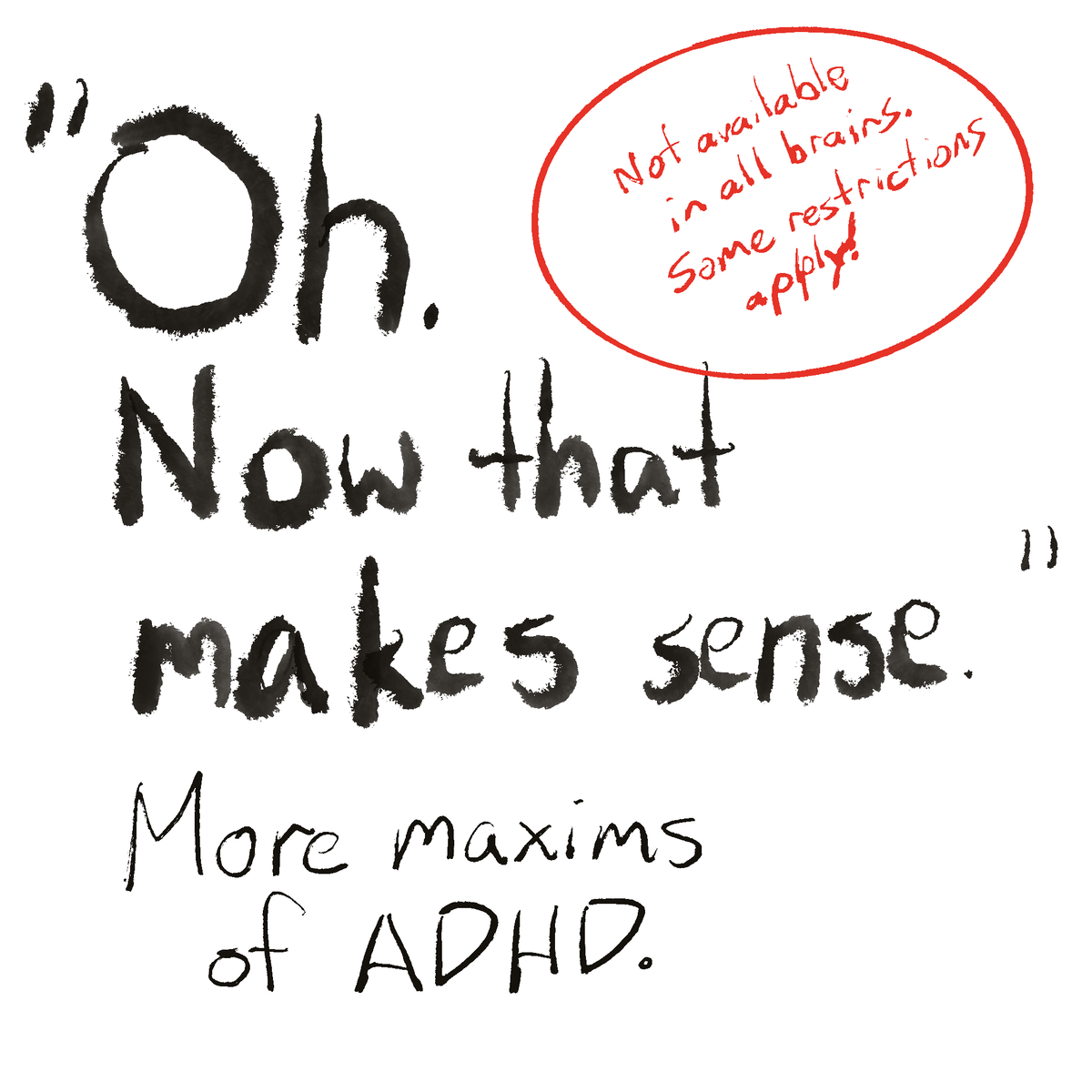
We know the Axioms; here’s some more uncomfortable truths
When I wrote about the lessons learned after the first two years of my (late) diagnosis with ADHD, I had quite a list.
Too much of a list, in fact, and it was with the help of my friend and fellow ADHDer Karl among others that I was able to distill them down into five fairly simple concepts. You can read about them here, but here’s a quick recap:
1. The Axiom of Stuff: Figure out where things want to live, and put them there, repeatedly.
2. The Axiom of Transitions: The speed at which you transition from one place to another is directly proportional to the likelihood that you will forget something, and the relative importance of the thing(s) you forgot.
AKA: Hurrying is kryptonite.
3. The Axiom of Magical Thinking: Your brain sees the world through a kaleidoscope — vivid, shifting, and full of possibility. Unfortunately it is not usually aligned with the reality others live in. Intentionality is your battle cry, and no side quests! is your shield.
4. The Axiom of Options: choice is friction, and just because you can optimize something to be three percent better than it was doesn’t mean you should spend fifty percent of your available time doing it.
5. The CRASH Axiom: Everything works, until it doesn’t. That’s the way the universe works, and while it may feel like that’s often your fault, it’s more often not. The Cognitively Responsible is Aware Shit Happens: CRASH.
6. The Brain Axiom: Your brain is beautiful. The difficulties come from trying to live in a strange world that wasn’t designed for people who think like you — so you do the best it can to get you what you need and what you want with the brain you have.
But wait, there’s more.
A lot of maxims, truisms, corollaries, and such got left on the metaphorical cutting room floor. In the interest of completeness and inclusion, here are some of the related phenomena that have epitomized my experience of ADHD:
- Murphy’s Law for ADHDers: “everything that can go wrong already has, you just don’t know it yet.” There’s always a low-key anxiety going on in the back of my head, waiting for the bank alert for an overdraft, the friend who’s waiting for me because I forgot our coffee date, the dreaded three words from the boss: “Where’s that report?” We spend so much time trying out organization methods because we dream of a system that will stop these unpleasant surprises. Not to succeed; just to feel a little more safe.
- Your Brain is a Liar. This is the brutally honest version of the “magical thinking” axiom. Just remember, any time you hear yourself say “I’ll just remember it,” “…it’ll just take a second,” or “I’ll put it away later,” your brain is lying to you.
- Lists are worthless by themselves. One of the ways your brain will fool you when you write down a task is to make you feel that you’ve accomplished that task. Spoiler: you haven’t. Your method should have three simple steps:
- Make the list. Put it somewhere obvious. But remember, your brain doesn’t see things that it doesn’t find interesting, so it will not be obvious enough. Proceed to B.
- Set a recurring alarm or timer to LOOK AT THE LIST YOU WROTE DOWN. That’s dead simple in Mac OS; “Hey, Siri, set a timer for two hours called ‘check your lists’.”
- Two hours (or whatever) later, your phone or watch or computer will buzz an alert: check your lists. NEVER IGNORE THE TIMER.
Imagine if a portal had opened up in thin air and a slightly older, more frantic version of yourself leaned in and said “Oh, thank God I’ve reached you from the future! I hope it’s not too late for me — you— us to fix it!”
Would you listen to them?
Guess what? That timer going off is literally a message sent through time from your past self telling you that you need to do something. Listen to them.
- Not everything can be blamed on ADHD…but more than you think. One of the reasons the internet is saturated with ADHD content is that along with improvements in the diagnostic methods there has been a huge amount of communication, research, and shared experiences that reveal challenges far beyond the “I forget things and get distracted easily” trope. I’ve written other articles about the side effects of simply knowing about your ADHD and how it works, but it comes down to this: while there are a lot of common and well-known characteristics of these kinds of neurodivergent brains, the ripple effects of how these affect your life are going to be far more personal and diverse. It’s my entirely unscientific opinion that the longer you lived without knowing, the deeper and more unknown these effects might be, disguised as “pet peeves” or “that’s just how I am”.
Not that you aren’t, or that a particular pet doesn’t peeve — but when you find out why, it gives you the ability to make an informed choice. - Don’t fix what ain’t broke. If that informed choice is “my brain is awesome, I’m not changing a thing!” that’s 100% valid. Along with all the improvements in diagnoses and accommodations has been the fact that many of us feel that our ADHD doesn’t need any D’s. Our brain doesn’t have a “deficit” nor is it a disorder — any more than a neurotypical brain has a surplus or is “ordered” (seriously, have you seen the neurotypical world, especially lately? What a mess.)
Sometimes you might be in places that are a little harder to exist in than others, but that’s not you, that’s the environment. Are humans suffer from ODBD (“oxygen-deficit breathing disorder”) when they try to swim?
No. They just have to paddle a bit harder when they’re playing with the fishes, and occasionally come up for air. That doesn’t mean they don’t belong in the water.
Before we drown in that metaphor, let’s just bring it to shore: Your brain works the way it should. Work with that instead of against it, everything gets easier and more fun.
What are your own truisms of ADHD? Or which of these don’t apply to you — either because you’re lucky or because you’ve figured out a workaround?


Comments ()